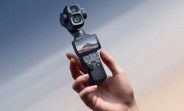
Following its initial announcement last month, DJI has officially expanded the global reach of its flagship vlogging camera, the Osmo Pocket 4P. The device is now available in key markets across Europe, Canada, and Australia, marking a significant step in its international rollout. However, due to the ongoing FCC ban on foreign-made camera and drone equipment, the Pocket 4P remains absent from the United States market.
Key Features and Specifications
Dual-Lens Camera System
The DJI Osmo Pocket 4P introduces a revolutionary dual-lens setup, a first for the Osmo series. This configuration includes an all-new 1-inch main sensor equipped with LOFIC (Lateral Overflow Integration Capacitor) technology, which enhances dynamic range and reduces highlight clipping. The main lens features an f/2.0 aperture and an equivalent focal length of 20mm, making it ideal for wide-angle vlogging and cinematic shots.
Video and Photo Capabilities
In terms of video, the Pocket 4P can record up to 4K resolution at 240 frames per second (FPS), allowing for ultra-smooth slow-motion footage. For still photography, it captures 37-megapixel images, ensuring high-resolution photos even in challenging lighting conditions. The combination of LOFIC technology and the larger sensor significantly improves low-light performance and overall image quality.
Design and Portability
Compact and User-Friendly
Despite its advanced features, the Osmo Pocket 4P retains the compact, pocket-friendly design that made its predecessors popular. The gimbal stabilization system has been refined to provide even smoother footage, whether walking, running, or shooting from moving vehicles. The device also includes a touchscreen interface for easy control and monitoring.
Market Availability and Restrictions
Global Launch Details
DJI has confirmed that the Osmo Pocket 4P is now shipping to customers in Europe, Canada, and Australia. Pricing varies by region, but it generally aligns with the premium segment of the vlogging camera market. The company has not provided a timeline for a US release, citing regulatory hurdles as the primary obstacle.
US Market Exclusion
The absence of the Pocket 4P in the US is directly linked to the Federal Communications Commission (FCC) ban on equipment from certain foreign manufacturers, including DJI. This restriction affects not only drones but also camera equipment, leaving US consumers without access to this latest model. DJI continues to explore options to comply with US regulations, but no resolution is imminent.
Comparison with Previous Models
Upgrades Over the Osmo Pocket 3
Compared to its predecessor, the Osmo Pocket 3, the Pocket 4P offers several key upgrades. The dual-lens system is the most notable addition, providing more creative flexibility. The LOFIC sensor improves dynamic range by up to 1.5 stops, and the higher video frame rate (240 FPS vs. 120 FPS) enables smoother slow motion. Additionally, the 37MP still resolution is a significant jump from the 12MP sensor on the Pocket 3.
Use Cases and Target Audience
Ideal for Vloggers and Content Creators
The DJI Osmo Pocket 4P is designed for vloggers, travel enthusiasts, and content creators who need a portable, high-quality camera. Its dual-lens setup allows for versatile shooting, from wide-angle landscapes to close-up details. The built-in stabilization eliminates the need for bulky gimbals, making it a convenient all-in-one solution for on-the-go recording.
Professional Applications
Beyond casual use, the Pocket 4P can serve as a B-camera for professional filmmakers, offering a compact option for tight spaces or secondary angles. The 4K 240FPS capability is particularly valuable for capturing fast-moving subjects, such as sports or wildlife, with stunning clarity.
Technical Innovations
LOFIC Technology Explained
LOFIC (Lateral Overflow Integration Capacitor) is a sensor technology that improves dynamic range by storing excess charge from bright areas, preventing overexposure. This allows the Pocket 4P to retain details in both shadows and highlights, a critical feature for outdoor and high-contrast scenes. The 1-inch sensor size also contributes to better light gathering and reduced noise.
Gimbal Stabilization Enhancements
The 3-axis gimbal has been updated with improved algorithms for smoother tracking and faster response times. This ensures that even rapid movements result in stable footage, reducing the need for post-production stabilization. The gimbal also supports ActiveTrack 5.0, which can intelligently follow subjects while maintaining composition.
Accessories and Ecosystem
Compatible Add-Ons
DJI offers a range of accessories for the Pocket 4P, including a wireless module for remote control, a waterproof case, and various mounting options. The device is also compatible with existing Osmo Pocket accessories, such as the expansion adapter and tripod mount, providing flexibility for different shooting scenarios.
Pricing and Value
Cost Analysis
While the exact price varies by region, the DJI Osmo Pocket 4P is positioned as a premium product, typically retailing between $600 and $800 USD equivalent. Given its advanced features, including the dual-lens system and high frame rate video, it offers strong value for serious vloggers and creators who demand top-tier performance in a compact form factor.
Future Prospects
Potential US Release
DJI has not ruled out a future US release, but it remains contingent on resolving the FCC ban. The company is reportedly working on compliance measures, such as manufacturing components in non-restricted regions, but no timeline has been announced. For now, US consumers may need to explore alternative purchasing options or wait for regulatory changes.
Industry Impact
The global launch of the Osmo Pocket 4P reinforces DJI’s dominance in the vlogging camera market, challenging competitors like GoPro and Sony. The inclusion of LOFIC technology and dual lenses sets a new standard for compact cameras, potentially driving innovation across the industry.