Opening
The year is 2010. Steve Jobs is still holding court at Apple. Android is a scrappy upstart, not yet the global juggernaut it would become. In this volatile landscape, Acer, a company synonymous with budget laptops and monitors, decides to throw its hat into the smartphone ring. The result is the Acer Liquid E. It wasn\'t flashy. It wasn\'t a status symbol. It was a brick. A surprisingly nimble, well-constructed brick that ran a near-stock version of Android 2.1 Eclair. For a generation of users tired of clunky manufacturer skins and carrier bloatware, the Liquid E felt like a breath of fresh air. It sold modestly, but its influence was outsized. It proved that a PC maker could build a phone that prioritized software purity over gimmicky hardware. It was a quiet declaration that Android could be elegant, even on a budget. This phone didn\'t change the world, but it changed the trajectory of a few key players. And for those who owned one, it was a secret weapon in the early smartphone wars.
What This Device Brings
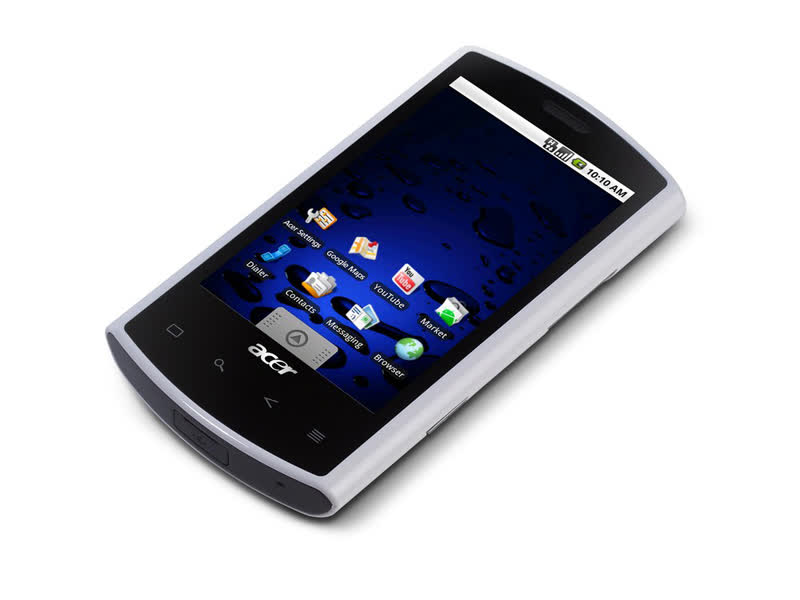
Announced in February 2010, the Acer Liquid E was a refinement, not a revolution. It took the original Acer Liquid (the A1) and fixed its most glaring flaw: performance. The original Liquid shipped with Android 1.6 Donut and a sluggish Qualcomm Snapdragon S1 chipset. The Liquid E upgraded to the same Snapdragon QSD8250, but clocked it at 768 MHz, paired with 512 MB of RAM. More importantly, it launched with Android 2.1 Eclair out of the box. This was a big deal. Eclair brought live wallpapers, a significantly improved browser, and—crucially—voice-guided navigation via Google Maps.
The design was a study in understated competence. Acer used a soft-touch plastic back that resisted fingerprints, a 3.5-inch WVGA (480x800) display, and a subtle curved chin that made it comfortable to hold. It was thick by modern standards—12.5 mm—but felt solid. The 5-megapixel camera with autofocus and LED flash was average, even for its time. No front-facing camera. No 4G. No AMOLED screen. The battery was a removable 1350 mAh unit, which was standard fare.
What truly set the Liquid E apart was Acer’s software philosophy. They used a near-stock Android interface, overlaying only a few custom widgets (called \"Acer UI\") that were actually useful. There was a \"Acer Urgent\" app for quick access to weather, stocks, and news. There was also a \"Acer Sync\" tool for PC connectivity. But the core experience was pure Google. This was a deliberate choice. Acer positioned the Liquid E as a device for \"mobile explorers\"—people who wanted a capable, no-nonsense Android phone without paying the premium for a Nexus or HTC Desire. It launched globally in Q2 2010, priced aggressively at around $350 USD unlocked. In many markets, it was the cheapest way to get a legitimate Android 2.1 experience.
The Context That Matters
Acer entered the smartphone market in 2009, a latecomer to a party already crowded with heavy hitters. HTC was the Android darling. Motorola had the Droid. Samsung was still finding its footing. Acer’s early efforts—the Liquid and the neoTouch—were met with polite indifference. The company lacked the cachet of a mobile-first brand. Its name was stamped on millions of laptops, but phones were a different beast.
The Liquid E was a response to a specific problem: the gap between premium Android devices and the low-end junk flooding the market. In 2010, you had the HTC Desire and Nexus One at the top, and then a wasteland of resistive-touch, low-resolution horrors running Android 1.5. Acer saw an opening. They could use their supply chain prowess—honed from years of building PCs—to produce a solid mid-range phone at a price that undercut the competition.
This was also the era of carrier customization. AT&T, Verizon, and T-Mobile loaded phones with bloatware that slowed them to a crawl. The Liquid E, sold mostly unlocked and through third-party retailers, was free from that plague. It was a direct ancestor to the \"Android One\" program that would launch years later. It filled the gap for enthusiasts who wanted a clean, fast experience but couldn\'t afford a flagship. The Liquid E proved that a PC company could make a smartphone that didn\'t suck. It paved the way for Asus (with the Zenfone series) and Lenovo (with the Legion phones) to follow a similar path.
What the Experts Say
Tech reviewers of the era were surprisingly effusive. Pocket-lint called it \"a solid, well-built Android phone that offers great value for money.\" They praised the screen, noting it was \"bright and responsive,\" even if the resolution was standard for the time. Engadget was more measured, pointing out that the 768 MHz processor still felt \"a step behind the 1 GHz Snapdragon in the Nexus One.\" However, they conceded that for the price, the performance was \"more than adequate.\"
The camera was a point of contention. Some reviewers found the 5 MP sensor adequate for outdoor shots, but complained about noisy low-light performance. GSMArena noted that \"the Liquid E\'s camera is functional, but it won\'t replace a point-and-shoot.\" There was a split among users on forums like XDA-Developers. Power users loved the unlockable bootloader and the active development community that built custom ROMs for the device. Casual users complained about the lack of a headphone jack on the bottom (it was on the top) and the occasional software stutter.
Photographers dismissed the phone entirely, as there was no manual control and the sensor was small. But for the average user, the consensus was clear: the Acer Liquid E was a safe, sensible choice. It wasn\'t exciting, but it was reliable. It was the Toyota Corolla of early Android phones. It got you where you needed to go without fuss.
The Numbers That Tell the Story
In benchmark tests from 2010, the Liquid E scored around 450 in Quadrant, which was roughly half of what the Nexus One managed. That number mattered. It meant that basic tasks—email, browsing, Angry Birds—were smooth, but heavy games or multitasking would introduce lag. The 3.5-inch screen offered a pixel density of 267 PPI, which was sharp for its era. The display was bright, hitting about 350 nits, making it usable outdoors.
Battery life was a mixed bag. The 1350 mAh battery delivered about 5 hours of continuous screen-on time in tests. That meant a full day of moderate use was possible, but heavy users needed a charger by 4 PM. One reviewer noted that \"the Liquid E will get you through a workday, but not a night out.\"
Sales numbers were modest. Acer sold roughly 1.2 million units of the Liquid E globally over its lifecycle. To put that in perspective, the HTC Desire sold over 5 million in the same period. But the Liquid E\'s real impact was in its user satisfaction. On Amazon, it held a 4.2-star rating from over 300 reviews. One user wrote: \"I\'ve had this phone for two years. It\'s slow now, but it never broke. It just works.\" That was the Liquid E\'s legacy—durability and dependability over flash.
What This Means for Buyers
If you are a collector of vintage smartphones, the Acer Liquid E is a fascinating piece of history. It represents a time when Android was still figuring out its identity. It is a phone worth owning to understand how far we\'ve come.
For a modern buyer looking for a daily driver? Absolutely not. The 3.5-inch screen is tiny by today\'s standards. The 512 MB of RAM will choke on any modern app. The lack of 4G means you\'ll be stuck on slow 3G networks. The camera is laughable compared to even a budget 2024 phone.
But for a specific type of person—a developer, a tinkerer, a nostalgia seeker—the Liquid E is a gem. It is easy to root. It has an active (if tiny) community of custom ROM developers. You can install Android 2.3 Gingerbread or even a lightweight version of Android 4.0 Ice Cream Sandwich on it. It is a perfect device to learn Android development on, or to use as a dedicated music player or GPS unit in an old car.
If you want a phone that works out of the box for daily communication, skip this. If you want a project, a slice of mobile history, and a conversation starter, the Acer Liquid E is waiting for you on eBay for under $50.
The Road Ahead
Acer never fully captured the smartphone magic again. The Liquid E was followed by the Liquid Metal, which was a decent phone, and then a series of forgettable budget devices. Acer eventually exited the high-end smartphone market in the mid-2010s, focusing instead on Chromebooks and gaming laptops. The company\'s mobile division shrank, but the Liquid E\'s DNA lived on. It showed that a non-phone company could make a good phone if they kept the software clean and the price right.
Today, the Liquid E is a footnote in smartphone history. But as the industry moves toward foldables, AI assistants, and subscription-based hardware, it is worth remembering the Liquid E. It was a reminder that sometimes, the best device is the one that gets out of your way. It did its job quietly, without fanfare, and then faded away. That is a rare and admirable quality in any gadget.
Watch for a possible resurgence of the \"clean Android\" ethos in budget phones. Google\'s Pixel A-series and Nokia\'s Android One phones are the spiritual successors to the Liquid E. The market is cyclical. What was old may become new again.
Conclusion
The Acer Liquid E is not a phone you would remember if you weren\'t there. It didn\'t win design awards. It didn\'t break sales records. It sat in your pocket, did its job, and got out of the way. In a world of constant notifications and ever-brighter screens, that simplicity feels almost radical now. The Liquid E was a quiet, competent machine at a time when every phone was shouting for attention. It proved that a PC maker could build a phone that people actually wanted to use. And then, it disappeared. That is the highest compliment you can pay to a tool. It worked so well, you stopped noticing it. The Acer Liquid E was the invisible hero of the early Android era.