
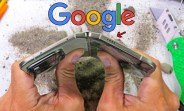
Just a couple of weeks after JerryRigEverything put the Samsung Galaxy Z Fold8 through its paces, the same torture test has now been applied to the Google Pixel 11 Pro Fold. The results are alarming, to say the least. While the phone survives the usual scratches and flame, the bend test exposes a critical vulnerability that Google has failed to address for the fourth consecutive generation. Let’s dive into exactly what happened and why this keeps occurring.
Scratch Test: The Display Holds Up, But Not Perfectly
As with every foldable that comes through his workshop, Zack begins with the Mohs hardness scale scratch test. The outer display of the Pixel 11 Pro Fold, protected by Gorilla Glass Victus 3, starts showing scratches at level 6, with deeper grooves at level 7. This is pretty standard for modern glass and nothing to be concerned about.
However, the inner foldable display is a different story. The ultra-thin glass (UTG) layer, which is still plastic-based in its composition, scratches much more easily. Even a fingernail can leave a permanent mark if pressed hard enough. Zack demonstrates that at level 2, the inner screen already shows visible indentation, which is typical for foldables but still a reminder that these devices require careful handling.
What About the Frame and Buttons?
The aluminum frame and the power button, which also houses the fingerprint sensor, are subjected to the razor blade. The frame scratches at level 6, and the button’s coating can be removed, but the sensor still works. The camera visor on the back, made of polished aluminum, is also prone to scratching, but that’s cosmetic damage rather than a structural issue.
Flame Test: A Quick Burn, But No Lasting Damage
Next up is the flame test. Zack applies a direct flame to the inner display for about five seconds. As expected, the plastic layer burns and leaves a white, dead pixel area. However, the phone’s self-healing properties kick in, and the burn mark slowly fades over the next few minutes. This is a common trick on foldables, but it’s still impressive to watch. The outer display, being glass, shows no damage from the flame.
Sand and Grit: The Real-World Enemy
One of the most realistic tests is pouring sand and grit over the phone. Zack demonstrates how easily these tiny particles can get trapped between the display and the hinge. When you close the phone, the sand can cause micro-scratches on the inner screen. He shows that even after a brief exposure, the display picks up several permanent marks. This is a reminder that foldables are not for beach days or dusty environments unless you’re willing to accept cosmetic wear.
The Bend Test: The Fatal Flaw Revealed
Now, the moment everyone was waiting for: the bend test. This is where the Pixel 11 Pro Fold fails spectacularly. Zack starts by bending the phone from the front, applying pressure to the center of the closed device. The phone resists initially, but then a loud crack echoes through the room. The back panel splits along the antenna lines, which run vertically on both sides of the device.
When he flips the phone over and bends it from the back, the same thing happens. The glass cracks along the same lines, and the structural integrity is compromised. The phone’s frame bends slightly, but the glass shatters. This is not a one-off issue; it’s a design flaw that has persisted across four generations of Pixel Fold devices.
Why Does This Keep Happening?
The problem lies in the placement of the antenna lines. These are plastic strips that allow radio waves to pass through the metal frame. However, they create weak points in the structure. When pressure is applied, the stress concentrates on these lines, causing the glass to crack. Google has used this same design for the original Pixel Fold, the Pixel 9 Pro Fold, the Pixel 10 Pro Fold, and now the Pixel 11 Pro Fold. Each time, the bend test results in the same catastrophic failure.
Other manufacturers, like Samsung, have addressed this by placing antenna lines in less stress-prone areas or by reinforcing the frame with additional internal supports. Google, however, has not made any significant changes. This is particularly frustrating because the Pixel 11 Pro Fold is marketed as a premium device with a high price tag, yet it fails a basic durability test that many competitors pass.
What Does This Mean for Users?
If you’re considering buying the Pixel 11 Pro Fold, this durability test should give you pause. While the phone will likely survive everyday use, it’s not built to withstand accidental bending or pressure. If you sit on it while it’s in your pocket, or if you accidentally apply force to the center of the device, the glass will crack. This could lead to expensive repairs, and Google’s warranty may not cover physical damage.
Is There Any Good News?
Despite this critical flaw, the Pixel 11 Pro Fold does have some redeeming qualities. The hinge mechanism feels solid, and the phone opens and closes smoothly. The displays are bright and vibrant, and the camera system is top-notch. The software experience is also clean and optimized for foldable use. But these positives don’t outweigh the structural weakness.
Comparison with the Galaxy Z Fold8
For context, the Galaxy Z Fold8, which was tested just two weeks ago, survived the bend test without any cracking. Samsung’s foldable bent slightly but returned to its original shape, and the glass remained intact. This shows that it’s possible to design a foldable that can withstand this kind of stress. Google has no excuse for repeating the same mistake.
What Should Google Do Next?
Google needs to go back to the drawing board and redesign the frame of its foldable. The antenna lines should be moved to areas that are not under direct stress during bending. Additionally, the company could use a more flexible glass or add a layer of shock absorption between the frame and the glass. Until then, the Pixel Fold series will continue to be a fragile flagship.
Final Thoughts: A Recurring Nightmare
The Pixel 11 Pro Fold’s durability test is a stark reminder that even the most advanced technology can be undone by a simple design oversight. Google has had four chances to fix this issue, and they’ve failed each time. While the phone may be great in many other aspects, its structural weakness is a deal-breaker for anyone who prioritizes durability.
If you already own a Pixel 11 Pro Fold, we recommend using a sturdy case and being extra careful not to put pressure on the device. If you’re on the fence about buying one, you might want to wait and see if Google addresses this in a future iteration. For now, the Pixel 11 Pro Fold remains a beautiful but fragile piece of hardware.