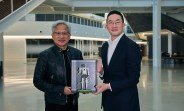
In a significant move that signals a deepening collaboration between consumer electronics and AI computing, LG Corp. Chairman and CEO Kwang Mo Koo recently visited Nvidia’s headquarters in Santa Clara, California. There, he met with Nvidia CEO Jensen Huang to sign a memorandum of understanding (MoU) aimed at expanding the AI capabilities of both companies. The partnership is set to accelerate developments in robotics and autonomous vehicle technology, with a headline-grabbing announcement: LG plans to unveil a humanoid robot in the first quarter of 2027.
The MoU outlines a joint effort to integrate Nvidia’s advanced AI platforms into LG’s upcoming hardware, particularly in the realms of robotics and self-driving systems. This collaboration is not just a handshake but a strategic alignment of two tech giants looking to lead in the next wave of intelligent machines.
LG and Nvidia: A Strategic Alliance for AI-Driven Innovation
The partnership between LG and Nvidia is a natural fit, combining LG’s expertise in consumer electronics, home appliances, and automotive components with Nvidia’s dominance in AI computing, graphics processing units (GPUs), and autonomous vehicle platforms. The MoU signed by the two CEOs is designed to foster innovation across multiple fronts, from smart home robotics to advanced driver-assistance systems (ADAS) and fully autonomous driving.
For LG, this collaboration is a step toward transforming from a traditional electronics manufacturer into a leading AI-driven solutions provider. For Nvidia, it represents another major OEM partnership that validates its AI ecosystem as the industry standard for robotics and automotive intelligence.
The Humanoid Robot: A 2027 Milestone
The most attention-grabbing aspect of the announcement is LG’s plan to introduce a humanoid robot in the first quarter of 2027. This bipedal robot, designed for general-purpose tasks, will be powered by Nvidia’s Jetson Thor, a compact yet powerful AI supercomputer designed for robotics. The Jetson Thor offers an impressive 2,070 TFLOPs of AI performance, enabling the robot to process complex sensor data, navigate dynamic environments, and execute tasks with human-like dexterity.
But the hardware is only half the story. The robot will also run on Nvidia’s Isaac GR00T, an open reasoning humanoid foundation model. This model provides the robot with a foundational understanding of the physical world, allowing it to learn from demonstrations, reason about objects and spaces, and adapt to new situations without extensive pre-programming. The combination of Jetson Thor’s raw computing power and Isaac GR00T’s cognitive capabilities is expected to make LG’s humanoid robot one of the most advanced in the market.
The 2027 timeline suggests that LG is aiming for a production-ready product rather than a research prototype. This aligns with industry predictions that humanoid robots will begin to see commercial deployment in homes and workplaces by the late 2020s. LG’s entry into this space puts it in direct competition with other tech giants like Tesla (with its Optimus robot), Boston Dynamics, and various Chinese robotics startups.
Powering Self-Driving Cars with Nvidia’s AI Hardware
Beyond humanoid robots, the LG-Nvidia partnership extends to the development of AI-powered hardware for self-driving cars. LG has been a key player in the automotive supply chain, providing components such as displays, batteries, and infotainment systems to major car manufacturers. Now, it aims to become a leader in autonomous vehicle technology by integrating Nvidia’s AI computing platforms into its automotive solutions.
Nvidia’s Drive platform, which includes the Drive AGX Orin and the newer Drive Thor, is already the go-to solution for many automakers and Tier 1 suppliers. By partnering with Nvidia, LG can leverage these platforms to develop advanced driver-assistance systems and higher levels of autonomy. This could include everything from surround-view cameras and radar processing to decision-making algorithms that enable safe navigation in complex urban environments.
The MoU specifically mentions the development of “AI-powered hardware,” which suggests that LG will not just be a consumer of Nvidia chips but will co-develop custom hardware solutions. This might involve integrating Nvidia’s AI accelerators into LG’s own electronic control units (ECUs) or creating new sensor fusion modules that combine data from multiple sources for real-time decision-making.
Why This Partnership Matters for the Autonomous Vehicle Industry
The autonomous vehicle industry has faced significant challenges in recent years, including regulatory hurdles, technical setbacks, and high costs. However, the collaboration between LG and Nvidia could help overcome some of these obstacles by bringing down the cost of AI computing and making it more accessible to a wider range of automakers.
LG’s manufacturing prowess and supply chain expertise can help scale Nvidia’s AI technology to mass production, while Nvidia’s software ecosystem provides the necessary tools for developing and deploying autonomous driving algorithms. This synergy could accelerate the time-to-market for Level 3 and Level 4 autonomous vehicles, where the car can handle most driving tasks but still requires human oversight in certain conditions.
Moreover, the partnership could lead to innovations in vehicle-to-everything (V2X) communication, where cars talk to each other and to infrastructure to improve safety and traffic flow. By combining Nvidia’s AI with LG’s communication technologies, the two companies could create a more connected and intelligent transportation ecosystem.
Nvidia Jetson Thor: The Brain Behind LG’s Robots
The Nvidia Jetson Thor is a marvel of modern engineering. It is a system-on-module (SoM) designed specifically for robotics and edge AI applications. With 2,070 TFLOPs of AI performance, it can handle massive neural networks in real-time, enabling robots to perceive their environment, plan actions, and execute them with precision.
This performance is achieved through a combination of a high-performance CPU, a powerful GPU, and dedicated AI accelerators. The Jetson Thor also supports multiple sensor inputs, including cameras, LiDAR, and radar, making it ideal for both humanoid robots and autonomous vehicles.
For LG’s humanoid robot, the Jetson Thor will be the central processing unit, handling everything from visual recognition to motion control. The robot will be able to identify objects, understand speech, and even predict human behavior, making it a truly interactive and helpful companion.
Isaac GR00T: The AI Model That Gives Robots Common Sense
While the Jetson Thor provides the computational muscle, the Isaac GR00T foundation model provides the intelligence. This model is part of Nvidia’s Isaac robotics platform, which offers a suite of tools for developing, simulating, and deploying robots.
Isaac GR00T is an open reasoning model, meaning it is designed to reason about the physical world in a way that mimics human common sense. It can understand spatial relationships, physical properties (like weight and fragility), and even social cues. This allows robots to interact with their environment in a more natural and safe manner.
For example, a robot powered by Isaac GR00T could be asked to “bring me a cup of coffee.” It would not just blindly follow a path; it would understand that it needs to locate the coffee maker, find a cup, fill it, and navigate back without spilling. This level of reasoning is a significant step beyond traditional robotic programming, which relies on pre-defined paths and actions.
The combination of Jetson Thor and Isaac GR00T is expected to make LG’s humanoid robot exceptionally capable, potentially rivaling the performance of robots that are currently being tested in research labs.
What This Means for Consumers and the Future of AI
For consumers, the LG-Nvidia partnership could bring advanced AI-powered devices into their homes and daily lives sooner than expected. Humanoid robots that can assist with household chores, care for the elderly, or provide companionship are no longer science fiction. With LG’s reputation for reliable and user-friendly products, these robots could become mainstream by the end of the decade.
In the automotive sector, the partnership could lead to safer and more intelligent vehicles. Self-driving cars that use LG and Nvidia technology might be able to handle complex driving scenarios, such as navigating through construction zones or reacting to unpredictable pedestrians, with greater reliability.
Moreover, this collaboration underscores the growing importance of AI in all aspects of technology. As AI becomes more integrated into everyday devices, the line between hardware and software will blur, and companies that can master both will have a competitive edge.
The Road Ahead: Challenges and Opportunities
While the partnership is promising, there are challenges ahead. Developing a humanoid robot that is both affordable and reliable is a monumental task. The robot must be able to operate safely in unstructured environments, handle unexpected situations, and be energy-efficient enough to run on batteries for extended periods.
Similarly, self-driving car technology still faces regulatory and public acceptance hurdles. Many people are skeptical about the safety of autonomous vehicles, and high-profile accidents have raised concerns. LG and Nvidia will need to demonstrate that their technology can significantly reduce accidents and improve road safety.
However, the opportunities are immense. The global market for humanoid robots is projected to reach billions of dollars by 2030, and the autonomous vehicle market is expected to grow exponentially. By partnering now, LG and Nvidia are positioning themselves to capture a significant share of these markets.
Conclusion: A Bold Step into the Future
The MoU signed by LG and Nvidia is more than just a corporate agreement; it is a declaration that the future of technology lies in AI-driven robotics and autonomous systems. By combining LG’s engineering and manufacturing capabilities with Nvidia’s cutting-edge AI platforms, the two companies are set to redefine what is possible in both the consumer and automotive sectors.
The announcement of a humanoid robot by 2027 is particularly exciting, as it brings us one step closer to a world where robots are not just industrial tools but personal assistants and companions. And with the development of AI-powered hardware for self-driving cars, we are moving toward a future where transportation is safer, more efficient, and more accessible.
As the partnership unfolds, it will be interesting to see how these technologies evolve and what new products emerge. One thing is certain: the collaboration between LG and Nvidia is a clear sign that the age of intelligent machines has truly arrived.